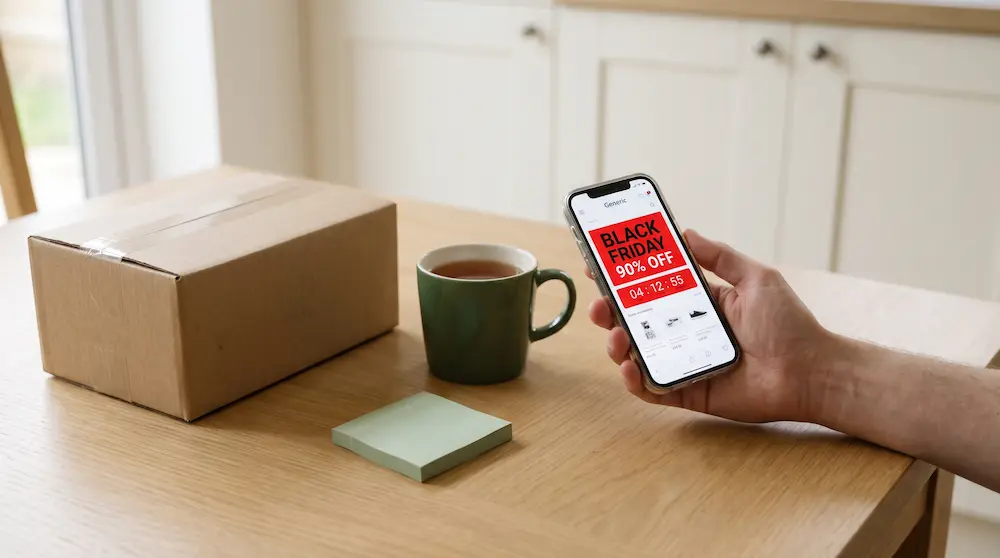
The most common Black Friday scams are fake online shops, deals that are too good to be true (often advertised on social media), and fake delivery texts about parcels you might genuinely be expecting. Your best protection is to shop with retailers you know, type their web address in yourself, pay by credit card where you can, and never pay a delivery fee through a link in a text. Black Friday is on Friday 27 November this year, but the deals and the scams run all month.
Why is Black Friday so busy for scammers?
Lots of people are buying, lots of parcels are moving about, and everyone’s in a rush to grab a deal before it ends. That’s exactly the mood scammers want you in.
It adds up, too. Action Fraud figures show more than £11.8 million was lost to online shopping fraud between November 2024 and January 2025. The National Cyber Security Centre has also warned that scammers are using AI to make fake adverts and websites look more convincing, so bad spelling isn’t the giveaway it used to be.
5 Black Friday scams to watch for
1. Fake online shops
These are websites set up to look like a proper shop, selling popular brands at 70% or 90% off. Sometimes they take your money and send nothing. Sometimes they send a cheap knock-off. Either way, your card details are now with a scammer.
Red flags to look for:
- A web address that’s a bit odd, like trainers-clearance-uk.shop
- No proper contact details or UK address, only a web form
- Reviews that are all gushing, or none at all
- Being asked to pay by bank transfer
2. Too-good-to-be-true adverts on social media
Facebook and Instagram ads for “closing down sales”, designer coats for £30 or the latest games console at half price. These adverts don’t get checked as carefully as you’d hope, and plenty of them lead straight to fake shops.
Before you buy from a shop you’ve never heard of, search for its name followed by “reviews” or “scam”. If people have been caught out, you’ll usually find out in a few seconds.
3. Fake delivery texts
“Your parcel couldn’t be delivered. Pay a £1.45 redelivery fee here.” These work so well in November because most of us really are waiting for something. The fee is tiny, but the fake payment page grabs your full card details.
Check on any delivery in the retailer’s or courier’s own app, or by typing their website in yourself. Never use the link in the text. If you get one, forward it to 7726 (it spells SPAM on the keypad) and delete it.
4. Fake order confirmations
An email or text about an order you didn’t place, often for something expensive like a laptop or a phone, with a number to call “if this wasn’t you”. The person who answers will try to get your bank details, or ask you to install software so they can “cancel the order” on your computer.
Never let anyone who contacted you out of the blue connect to your computer. If you’re worried about an order, log in to your account the way you normally would and check there.
5. Gift card and “free prize” scams
A survey that promises a £500 voucher, or a seller who wants paying in gift cards. No genuine shop asks you to pay with gift cards. Once the code’s been shared, the money’s gone and it’s almost impossible to get back.
How can I shop safely on Black Friday?
- Go to the shop yourself. Type the web address in, or use the shop’s own app, rather than clicking links in emails, texts or adverts.
- Pay by credit card if you can. Under Section 75 of the Consumer Credit Act, your card provider shares responsibility for purchases between £100 and £30,000. Debit cards and PayPal give you some protection too. Bank transfers to a shop you don’t know give you next to none.
- Check the price elsewhere. If a well-known retailer is selling the same thing for twice the price, the bargain probably isn’t real.
- Only give what’s needed. Use guest checkout where you can, and don’t save your card details on a site you’re unlikely to use again.
- Lock down your shopping accounts. Turn on two-step verification for Amazon, eBay and your email, and use a different password for each one.
- Keep an eye on your bank statements through December and January for anything you don’t recognise.
What should I do if I’ve been scammed?
First things first: don’t feel daft. These scams are made by people whose full-time job is fooling others.
- Call your bank straight away. Dial 159 from most UK phones to get through to your bank safely, or use the number on the back of your card.
- Report it to Report Fraud at reportfraud.police.uk or on 0300 123 2040. Report Fraud replaced Action Fraud in December 2025.
- Forward scam texts to 7726 and scam emails to report@phishing.gov.uk.
- Report fake adverts to the social media site, using the three dots on the advert.
- If you entered a password on a fake site, change it now, and anywhere else you use the same one.
Frequently asked questions
When is Black Friday 2026?
Black Friday is on Friday 27 November 2026, and Cyber Monday is on 30 November. Most big retailers start their sales in early November, so expect scams to start then too.
How can I tell if a website is a scam?
Check the web address carefully, look for real contact details and a UK address, search the shop’s name with “reviews” or “scam”, and be wary of any site that wants a bank transfer. If the prices are miles below everywhere else, trust your gut.
Does the padlock in the address bar mean a website is safe?
No. The padlock only means your connection to the site is encrypted. Scam websites can have a padlock too, so it tells you nothing about whether the shop is genuine.
Is it safer to pay by credit card or debit card?
Credit card, if you can pay it off. Section 75 protection covers purchases between £100 and £30,000. Debit cards can sometimes get your money back through a “chargeback”, but it isn’t a legal right in the same way.
Do couriers really send delivery texts?
Yes, many send genuine tracking updates, which is exactly why the fake ones work. The safe habit is to check every delivery in the courier’s or retailer’s own app, whatever the text says.
Not sure if a deal is real?
If you’re in Milton Keynes and you’ve spotted a bargain that feels a bit too good, send me a screenshot or the link on WhatsApp, or give me a ring on 07719 694943. I’ll help you check it before you buy. And if you’ve already been caught out, I can check your laptop or phone at home or remotely.
More on staying safe: Scam texts: 5 red flags and what to do · How to spot a phishing email (and what to do if you get one) · Password managers explained in plain English